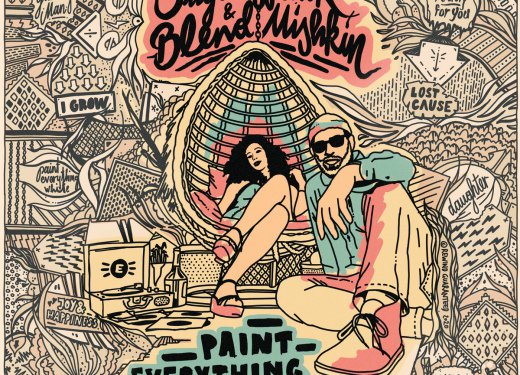
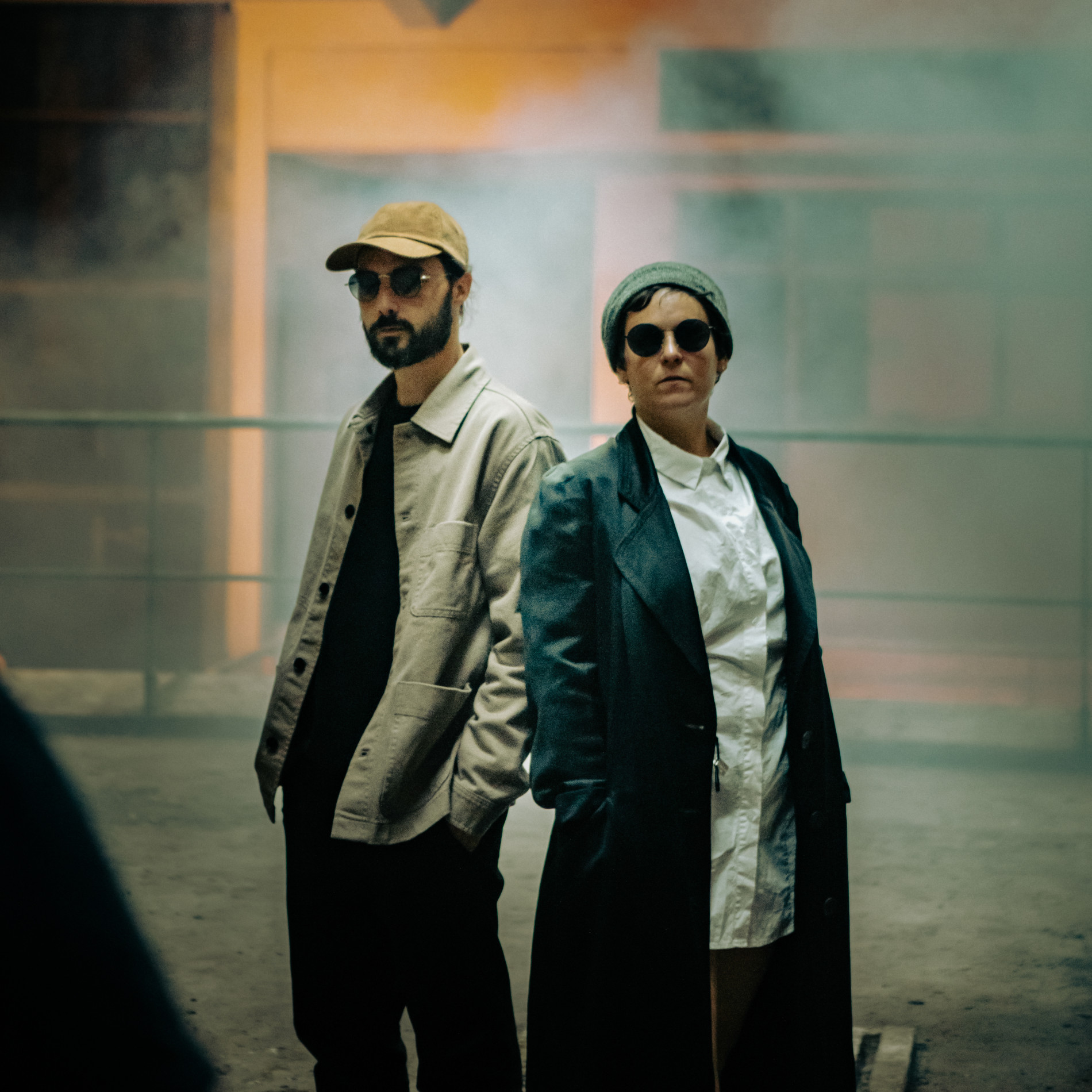
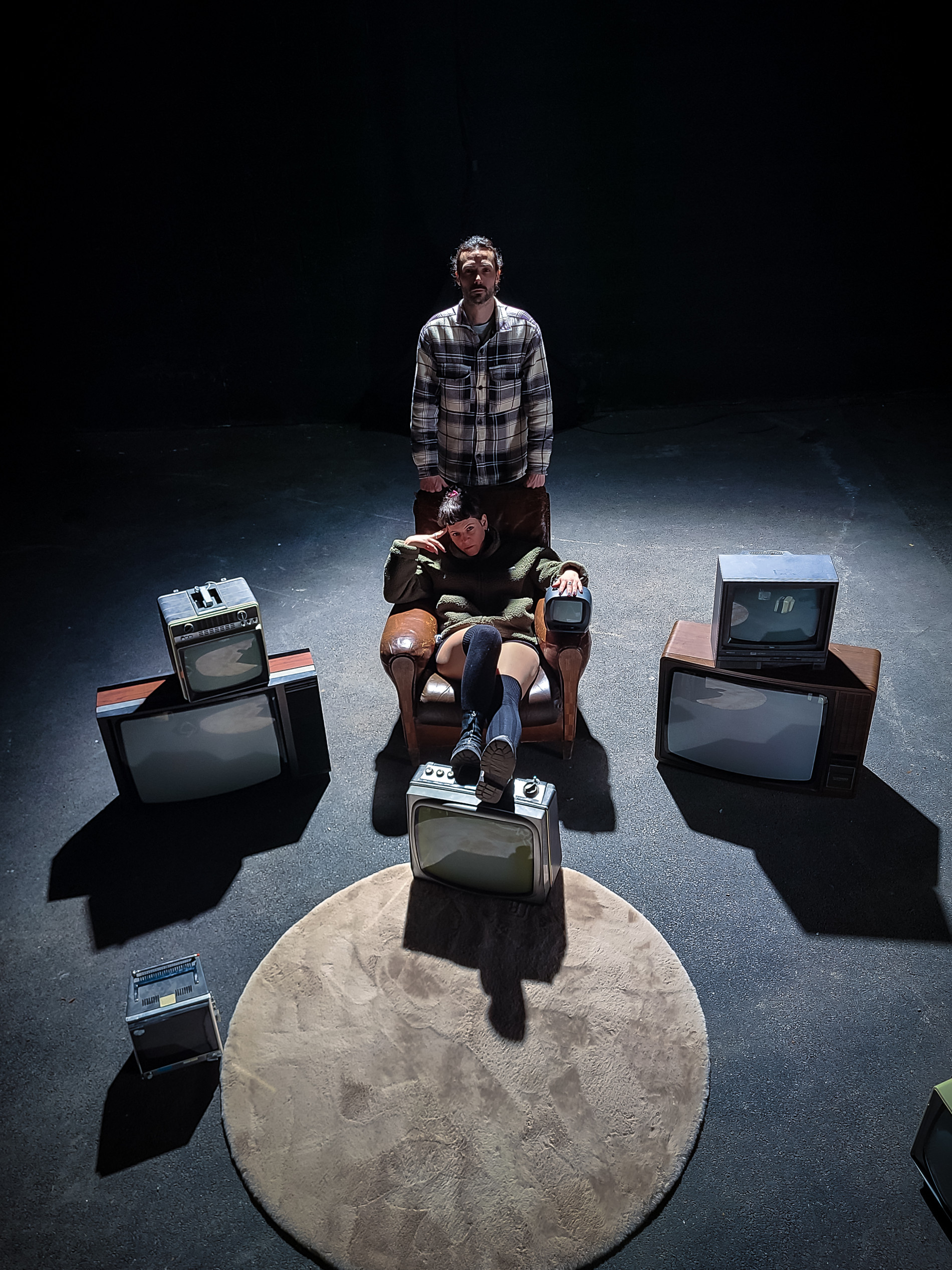
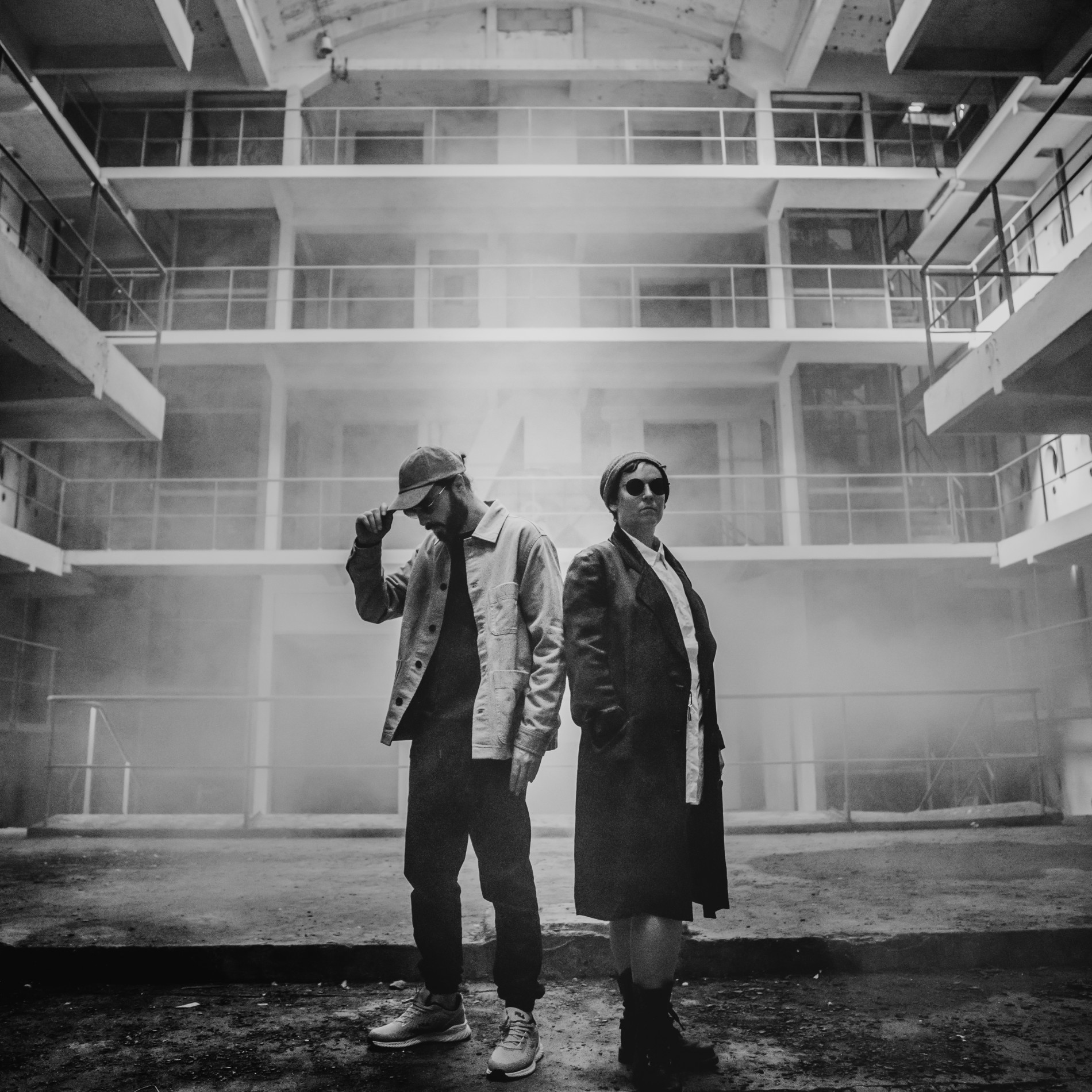
Ahead of their 28 May 2026 show at Control Club's Berlin Room in Bucharest, presented by EMAGIC, FRIZZY P & MR COLE spoke with Black Rhino Radio about the architecture of their music. The Paris-based duo make songs that feel handmade and lived-in, built from Mr Cole's sample dust and low-lit grooves, and Frizzy P's voice moving between confession and cadence.
Frizzy P and Mr Cole first began working together after meeting at a benefit concert linked to a festival project in Mali, though the collaboration took years to fully take shape. In the conversation that follows, they reflect on the latest in the LADI DADI series, the corridors of The Backroom Tape, and the way hip-hop, jazz, trip-hop, and personal writing continue to move through their music without ever settling into a single genre.
Frizzy P: No, and we're really excited to go. We had a couple of friends who wanted to join us because they were saying, "Oh wow, you're going to Bucharest," but it turns out they can't come anymore, so we'll be on our own. It's really exciting. To be honest, we discovered through the posts and the different Instagram pages everything that seems to be happening in the scene there, and it felt really vibrant and on point. With everything you wrote in your profile, it felt like there is a strong culture around hip-hop, especially boom bap. It really spoke to us. We're excited to come over, share this together, and see what's going on.
Frizzy P: No, not at all. Actually, a lot of the cities we're going to on this mini-tour are places we haven't been to before. Munich, Vienna, Luxembourg, Romania. It has this double effect for us. It is both a discovery, in the sense of going abroad to play our music, and also a way of getting in touch with scenes we did not really know about. That makes it extra special.
Frizzy P: I'll translate what Pablo says, but I think what is poignant about what you say is how some albums translate the vibe of a city or a place. It shows how much the city is present in the music you hear, to the point where you can almost dive into the city through the music, even if you have never been there.
Mr Cole: For me, New York is connected to jazz and blues. My father passed on jazz to me, and that style became important. New York, for me, has the perfect sound because of that jazz feeling. It is not West Coast. East Coast and West Coast are different. I like West Coast music too, but I prefer the jazz vibe and the melancholy of East Coast music. My second favorite album is The War Report by Capone-N-Noreaga. That feels close to French rap.
Frizzy P: There's no temporality to it. It's classic and universal.
Frizzy P: I think that aspect of music traveling is really important. We are both children of the 90s. We grew up in that period, and it shows how music can travel. I like that you mentioned Nas as an artist who really spoke about New York City, because we were in another country and still able to connect with that.
It also says something about a generation. This is part of our story too. I'm French, but I grew up in London, so music was already traveling through my own cultural identity. I grew up with British radio and British sounds, even though I was French. That was my main access to music. Then, upon returning to France, French hip hop was, in its own way, closely connected to American hip hop. All of that travels. It shows how a whole generation can speak the same language through music. We were in different parts of the planet, yet we connected through shared emotions and cultural phenomena. It marked us.
Frizzy P: I think we both had that moment, but at different times. Pablo was the first. We met at a concert where we were both playing. He was playing with his band, and I was playing on my own. For him, it immediately felt obvious that we should work together. He offered to do so straight away.
For me, it took more time. I was in the UK and working on other things. I'm also a producer, so at that time I was experimenting more with techno, underground club music, and even noise. I wasn't really projecting myself back into singing or rapping. I was focused on the production side of my practice.
It was only when I came back to Paris to live there that it started to make sense. Pablo was great about it because he was determined, but he never put pressure on me. Even though it took us two years to really meet up and start the project, he would contact me every once in a while and send me a track. When I came back and saw the history of the messages, I thought, "This is actually great. I already have components to work with." It hit me that I should do this project with him. I should go back to hip hop and back to what I first started doing. I hadn't been singing or rapping for a few years, so that was the moment when I thought, yes, I definitely want to go back to this. From there, it started.
Frizzy P: To be honest, I'm still a little confused by it sometimes, or not always sure how to make it fit with what we do. It is definitely part of what infused me and what I was listening to. The trip-hop era is also the 90s, so, of course, it is part of the background. But it is not always the main thing.
Sometimes it comes more to the front, especially when I'm singing more and rapping less. In those moments, it can be more obvious. But it is not always there in the same way. It is more like a backdrop, something we allow ourselves to visit. Sometimes it is in the foreground, sometimes in the background.
Frizzy P: For me, what Dummy put forward is that there is a huge hip hop beat inside it. To me, it is hip-hop, in a way. That was triggering for me, and I'm sure for a lot of people. There is also the fact that a woman was bringing her own touch to these very hip-hop instrumentals. The beats and groove are definitely hip-hop, and then she brings in this very soft, ethereal singing voice. I found that completely mind-blowing.
Sometimes, with music or films, a sound has such a deep impact that it gets into your DNA. It comes out later, without you even noticing, because it helped shape your musical identity.
There was also, in a very different way, Lisa Ekdahl. I remember listening to her a lot. She had this approach to jazz, with a very small, almost tiny voice and an ethereal groove and sound. That marked me too. I find it close to hip-hop in a way, thanks to that mix of jazz, hip-hop, underground sounds, and more electronic textures. It all fits together in different ways. Morcheeba as well. A lot of female voices shaped me.
Mr Cole: For me, there is never just one approach to sampling. You can take one sample and create many different directions from it. That is where creativity comes in.
I am always looking for the harmonic or melodic aspect in a sample. Sampling begins with a passion for vinyl and the sound of vinyl, the texture and the organic quality of it. That is the first thing, the sound and how it comes out. Sometimes I will also play something and then put it back into the machines to get that texture again.
A sample means you are not starting from nothing. There is already a mood inside it. Then the work is to draw that out, exploit it, expand it, and hear the hidden things inside. With pitching, stretching, and working with time, you hear something different each time.
Frizzy P: For me personally, there is something about that name that still fits what it represents for us. Slick Rick was a rapper I listened to a lot. I was mesmerized by the contrast in him. He could have that gangster quality, but he rapped in this calm, detached way. I always found that amazing. There is also a lot of comedy in what he does, and a musicality in his rapping that I love. I feel that this is also a direction I like to work in.
We made it a trilogy, but there could be more one day. Maybe someday we will want to return to that sound and do a number four or five. You never know. But for now, we felt we wanted to try something new and step out of it. Still, when we work on tracks, we often recognize that something has a LADI DADI quality. We'll say, "That's LADI DADI." There is something coherent in that whole package for us.
Frizzy P: We started, and there was a long pause in between because it took us a while to get to know each other. If you're going to have a long-term project, you need to understand the person you're working with. You can meet someone and have a great interaction musically, but that does not necessarily mean you will keep making music together. That is fine too. But I think we both wanted something deeper. We needed time to explore our relationship and the music we were making.
After a while, the idea of the trilogy made sense. We also liked the idea of being creative with how we released music. A trilogy is unexpected. When people heard LADI DADI, they had no idea there would be a second or third part. I found that fun, and I think it fits our way of working.
Frizzy P: It was a continuation, and I think that is what it will keep being for us. We are not very concept-driven in the sense of deciding beforehand, "We are going to make this type of music." We like to understand each other first, to see where we are both coming from as people and in our approach to music.
The door we opened was wide. There is intention behind it, but we are not trying to calculate too much. That matters to us because we want to maintain a sense of authenticity and be true to what we are putting out there. Through the years, we learned that we really match in that sense.
Frizzy P: I think I'm just trying to navigate my own feelings as a human being, as a woman, and as someone moving through the world and the music industry. I experience life the way it comes at me. My way of working has always been close to that. Even before I made music, when I was younger, I wanted to be a writer. In French, we talk about automatic writing, and for me, it is close to a diary or journaling approach, writing through emotions and what you are going through.
I always had that approach to writing. It comes from a necessity and an urge to write what I am going through. It is liberating in many ways. I feel that it is the only way I can be true to whoever is listening to the music. I can write more intellectually or conceptually, but I am not sure that interests me as much. I like being extremely close to the inner world. There is a darkness there, a very intimate realm, and I find that the most interesting place to write from.
Frizzy P: The piggybacking you mention definitely exists. In hip hop and French rap, people often question a rapper or artist's legitimacy to speak about social struggle or politics. But I don't think we are trying to do that in a programmatic way.
Most of our songs are closer to spoken word in some sense. They are more like inner poetry or an inner voyage. When there is a political aspect, I feel that as a human being and as a woman, I am allowed to have my own voice and opinion on what I am going through in life and in the world, and how it makes me feel. I am not trying to force a political position onto the music. What I state is something I feel, but I'm sure many women and many people generally feel similar things.
I also write about many other subjects: more therapeutic things, my relationship to my own body, my emotional life. The politically motivated sounds are just one part of who I am. I'm painting a picture of myself as a human being and of everything that connects to me. Our music shows all of those different aspects. It is not focused on one.
Frizzy P: Exactly. We are complex people. I don't want to stand on one theme and repeat it endlessly. It won't be only political, and it won't be only about love stories either. That is the reality of being human. We are a lot of different things.
He [Pablo] didn't agree with me at first. That was where we had to negotiate. For him, the tracks could have been on LADI DADI. For me, it was more complicated.
We both felt that the LADI DADI releases were not only about individual tracks, but about the whole long play of the piece. When we listen to the album, we want there to be a sort of storyline or mood. The whole package needs to mean something. Every time we tried to include those tracks in one of the LADI DADI projects, they shifted the mood or did not fit within the whole project in the right way.
That is why they became The Backroom Tape. The title suggests the back door into LADI DADI. It is a way of explaining how these inside sounds and tracks still belong to that world, but from another angle. Some of them were among the first tracks we played on stage when we started. They are really old tracks.
Frizzy P: Yes. Actually, a lot of the live set is made up of tracks from The Backroom Tape. So yes, they are part of the project, but their placement came from a discussion between us.
Mr Cole: Flynt. His album J’éclaire ma ville. Beautiful production. Very New York in spirit. Again, there is this idea of the city.
Also Booba, Temps mort, and Lunatic.
Frizzy P: I have one that is one of my favorites. You should be able to find it on YouTube. It is Lone, from the 90s. There is Busta Flex on it when he was about nineteen, before he was famous. Busta Flex is also a great French reference. The track is "Cool dans la place". I listened to that album again and again. I absolutely love it.